| The Reverend Francis Orpen Morris |
|
The Rev F O Morris collaborated with Benjamin Fawcett for almost fifty years. He wrote the text for a History of British Birds and many other works that were illustrated by Fawcett and Lydon. Despite this long association it seems that their relationship was not particularly harmonious. There are pages and pages of criticisms and corrections in the archives that Morris sent to Fawcett concerning the illustrations for Birds. That said, the relationship did stand the test of time and resulted in one of the most impressive bodies of work produced during the nineteenth century.
Francis Orpen Morris was born on 25th March 1810 in Cove on the Great Island in Cork Harbour. Cove was renamed Queenstown in 1849 following the visit of Queen Victoria and was the last port of call of the Titanic before it set sail on its ill-fated voyage to America on 11th April 1912. Queenstown was renamed Cobh around the time of the establishment of the Irish Free State in 1922. F O Morris was the eldest son of Rear-Admiral Henry Gage Morris (1770-1851) and Rebecca Newenham Millerd Orpen who married in 1805. Henry was born in New York on 27th March 1770 where his father, the Honourable Lieutenant-Colonel Roger Morris (born 28 January 1727, died 13 September 1794), was a member of the Governor's Council. Roger was the son of Roger Morris (1695–1749), a renowned architect, and his second wife, Mary, daughter of Sir Peter Jackson, a Turkey Merchant. A Turkey Merchant was not someone who sold turkeys! A Turkey Merchant was a member of the Levant Company trading with the Ottoman Empire and the Levant. Sir Peter's wife, Mary, was the great great granddaughter of Henry Vandeput of Antwerp who fled to England from the Netherlands in 1568, with a considerable fortune, to escape the persecution of the "Iron" Duke of Alba.
During the French and Indian War (the North American theatre and precursor of the global Seven Years War, 1756–63) Lieutenant Roger Morris was Aide-de-Camp to the Commander-in-Chief of the British Army in North America, General Edward Braddock. On 9th July 1755, against the advice of colleagues and despite the Indian's offer to negotiate a French withdrawal, Braddock led a force to take Fort Duquesne (now downtown Pittsburgh). After crossing the Monongahela River, Braddock came up against the French and Indians heading south to meet them. A bloody battle ensued and Braddock suffered a disastrous defeat. The British took heavy losses, Braddock was mortally wounded and died four days later on 13th July. Roger Morris was also wounded and was attended to by his fellow Aide-de-Camp, 23 year old Lieutenant-Colonel George Washington, who had taken command after the death of Braddock. This battle has been described as an "unprecedented rout of a modern and powerful army" and a "pivotal moment in American and world history". Had Washington not survived American revolutionary history may have played out very differently. F O Morris published An Account of the Battle of the Monongahela River from an Original Document of One of the Survivors in 1854, published by Groombridge and printed by Blakeston of Driffield. It doesn't state who the survivor was.
Shortly after the Battle of the Monongahela, or "Braddock's Defeat" as it is known, George Washington travelled to New York to visit his close friend Colonel Beverley Robinson with whom he had served under Braddock. Here he met Robinson's sister-in-law, Mary Philipse (born 3 July 1730, died 18 July 1825), affectionately known as "Miss Polly". Mary was the daughter of Frederick Philipse, second Lord of the Philipsburg Manor and from a family of Dutch settlers. Mary, along with her sister, Mrs Susannah Robinson and brother Philip, had inherited a number of large estates through their father Frederick from an unmarried uncle, Adolphus Philipse. The original estate, the Philipse Patent, amounted to about 250 square miles or 160,000 acres. Mary's share was 51,102 acres.
Washington was very much enamoured by Miss Mary Philipse. In 1757, after leaving the Robinson's on military matters, he confided his affections to a close friend and colleague, Joseph Chew. Chew was a regular visitor to the Robinsons. On 13th July 1757 Chew writes to Washington earnestly advising him to return as Mary had another suitor. That suitor was Roger Morris, described by Chew as "a ladys man, always something to say." It wasn't until "late one winter's evening" that Washington eventually arrived at the Robinson's. Morris had already proposed to Mary and had been accepted. Roger and Mary were married on 19th January 1758 with all the leading families and military personnel of the area in attendance. It was the social event of the year with guests arriving in horse-drawn sledges at the Morris's house in the centre of their estate in what is now Yonkers. Two weeks before the wedding Mary had deeded all her property to her sister and Beverley Robinson to be held in trust for their, as yet, unborn children. This was to prove a very significant act many decades later.
Roger and Mary Morris now owned large tracts of land in New York. After Morris retired from the army in 1764 they built a mansion on a 130 acre site in Manhattan where they lived for ten years. F O Morris's father, Henry Gage Morris was born during this period. The mansion was in the Palladian style with Tuscan columns and a unique two storey octagonal room to the rear. The Morris Mansion played a significant part in American revolutionary history and features in the hit Broadway musical "Hamilton" which has recently opened in the West End and where it received nine Olivier Awards. The creator of "Hamilton", Lin-Manuel Miranda, was inspired by the Mansion and wrote much of the musical there. More of Hamilton below.
It has been said that the mansion was designed by Roger Morris's uncle but that is pure speculation, repeated across the Internet, and there is no indication as to who that might actually be. Robert Morris (1701-1754) is also mentioned as a possible designer but he is probably a cousin. Robert was primarily a writer on architecture rather than a practising architect. He wrote The Architectural Remembrancer, a book of designs, some of which do show a resemblance to aspects of the Morris Mansion. Roger Morris's father, Roger Morris (1695–1749), was a renowned architect who favoured the Palladian style. He designed the White Lodge in Richmond Park with Lord Pembroke in 1727 which does have some striking similarities to the Morris Mansion in New York. (Pevsner described the White Lodge as "design at it worst"!)
Roger was presented with a silver cup by Lord Pembroke in 1734 on which he had inscribed "Given by my noble patron Henry Earl of Pembroke,
by whose favour alone I am enabled to fill it. R Morris 1734." The cup has a cartouche of the architect Inigo Jones surrounded by the tools of the architects trade. It was mentioned in
Country Life Magazine in 1952.
Robert and Roger Senior had both died over ten years before the Morris Mansion was conceived. I am grateful to Professor Steven Parissien for his clarification of the Morris relationships (Prof. Parissien's 1989 PhD Thesis is entitled The Careers of Roger and Robert Morris, Architects). In his definitive work on the history of the house, The Jumel Mansion 1916, William Henry Shelton makes no mention of Roger Morris Senior or Robert Morris, in fact he does not mention an architect at all. He describes the Mansion as "Georgian, but of a peculiar English type." Carol S Ward in Images of America Morris-Jumel Mansion 2015 states that the architect is unknown. It seems likely that Roger Morris was influenced by the architecture of his father, Roger, and his other relative, Robert, and engaged local architects accordingly. In 1759 Robert Morris published a collection of Lectures on Architecture in which he has a dedication to his mentor, Roger Morris, signed by his "Loving Kinsman and Humble Servant, Robert Morris."
As the American War of Independence loomed Roger Morris's loyalties were divided. He remained loyal to the British Crown and returned with Mary to England. It was a loyalty that cost him dearly. The Morris Mansion served as headquarters for both sides at various times during the war. George Washington occupied the Mansion from 14th September to 20th October 1776 during which time he had his first success on the battlefield at Harlem Heights on 16th September 1776. The Mansion was subsequently taken over by the British Lieutenant General Sir Henry Clinton.
After the end of the Revolution, Roger and Mary were condemned as traitors. Their property was confiscated and they remained in England. Some complicated legal proceedings followed many years later regarding their property and its ownership and inheritance, more details below. The Mansion was used as a farmhouse and then became a tavern known as the Calumet Hall.
George Washington was elected the first President in 1789. The Morris Mansion hosted numerous cabinet meetings during Washington's presidency. Vice President John Adams, Secretary of the Treasury Alexander Hamilton, Secretary of State Thomas Jefferson and Secretary of War Henry Knox all fought their corner in what were lively and sometimes acrimonious exchanges.
Alexander Hamilton came from humble beginnings on the island of Nevis in the Caribbean. He was an excellent administrator and a protégé of George Washington. He was one of the Founding Fathers, he helped draft the Constitution and was the architect of the American financial system. His portrait is on the $10 bill. He was aloof and arrogant though, which did not endear him to his colleagues, including Washington. Hamilton was a soldier, lawyer, politician whose career was to some extent mirrored by his rival Aaron Burr. Burr ran for President in 1800 and tied with Thomas Jefferson. Hamilton described Burr as "inferior in real ability to Jefferson" which swayed Congress and resulted in a victory for Jefferson. Burr also ran for Governor of New York in 1804 and lost that race as well following damning criticism in the press by Hamilton. Burr blamed Hamilton for both these defeats. He challenged him to a duel which took place on 11th July 1804. Hamilton got the first shot in and missed. There is some speculation that it was a deliberate miss to invite his opponent to abort the duel. Burr, however, hit Hamilton who died from his wounds the following day. Burr had previously fought a duel with John Barker Church over banking matters in which they both missed and apologies were accepted. Duelling was illegal at that time and Burr was charged with murder. He was never found guilty but it was the end of his political career.
The Morris Mansion was bought in 1810 by Stephen Jumel, a French merchant. Jumel was married to Elizabeth 'Eliza' Bowen. Both were from humble beginnings but ambitious. They split their time between France and New York. Jumel's businesses suffered during economic depressions but Eliza was very astute and assured their financial stability by carefully controlling their investments. During their travels Eliza had amassed what was widely regarded as Americas first great collection of European art. Jumel, aged 70, died in 1832 in what were rumoured to be suspicious circumstances involving falling from a carriage and landing on a pitchfork. Just over a year later Eliza married 77 year old former vice President Aaron Burr. They separated after four months with a divorce finalised on the day of Burr's death on 14th September 1836. Alexander Hamilton's son was her attorney. Eliza continued to travel but she became more and more eccentric and reclusive. Having spent her last six years in isolation at the Morris-Jumel Mansion she died in 1865 in her 90s.
The City of New York purchased the Morris-Jumel Mansion in 1903. It still exists today as a museum. It is the oldest house in Manhattan and is designated as a National Historic Landmark. The grounds in which the Mansion sits are known as Roger Morris Park.
After the Morris Mansion was confiscated by the state following the Revolution it was broken up into farmsteads and smallholdings with over 700 families resident on the land and their title guaranteed by the state. In 1809, an eagle eyed lawyer had surmised that the state had no right to confiscate the land in the first place and that the families had no legal title to their properties. Because of Mary's actions in setting up a trust for her unborn children two weeks before she married Roger, the Morrises had a legally binding life lease that was passed from generation to generation. The lawyer informed John Jacob Astor. Astor was born in Germany where he was a flute maker with his brother George. He emigrated to America via London in 1781 aged 18. He tried to make a living selling woodwind instruments though his first job was peddling cakes for a baker. He then started peddling furs and became a fur trader. As soon as he had enough money behind him he became a property speculator. Astor was ruthless, inhumane and corrupt. Nothing was to stand in his way in the pursuit of money. Astor sought out every living heir of Roger and Mary Morris, and, by deceit, bought out all their legal rights to the property for $100,000. Astor then threatened to evict the 700 families from the Morris estate with no compensation. There was outcry. At this point he offered to sell the rights to the state for $667,000. The case dragged on through the courts for years. Eventually in 1827 it was determined that Astor had proven his case. The state agreed to pay him $500,000, the equivalent of about $12 million today. This was the start of Astor's road to a vast fortune eventually becoming America's richest and probably most hated man. He died on 29th March 1848. His great grandson, John Jacob Astor IV died on the Titanic in 1912. He was the richest passenger on the ship with his family's vast fortune forged at the expense of the native American people, the hard-working immigrant population and the Morris family.
Roger Morris died in York on 13th September 1794 aged 67. Mary also died in York at the age of 95 in 1825. They are commemorated with a monument at St Saviour's Church. The monument was removed during renovations in the 1980s (thanks to Ellie Drew, York Archaeological Trust, for supplying information and images). Mary Philipse will be forever known as George Washington's first love and for being unfairly declared a traitor while remaining loyal to her husband. She was also renowned as being one of the most elegant and accomplished ladies of the day who charmed everyone who knew her. In our story she is simply the grandmother of Francis Orpen Morris.
[Follow this link to shed light on a historical controversy - Myth and Misinformation]
F O Morris's mother, Rebecca, born 21st August 1784, was the daughter of the Reverend Francis Orpen, Vicar of Kilgarvan and Rector of Dangorney and Douglas in Ireland. Morris spent his childhood on the west coast of Ireland where he developed his interest in natural history. The family moved to England in 1824 and settled in Charmouth, Dorset in 1826. Morris continued his education at Bromsgrove School and read Classics at Worcester College, Oxford where he graduated in 1833. At the time of his death on 24th November 1851, 82 year old Henry Gage Morris was living at 17 Keldgate, Beverley, East Yorkshire with his wife Rebecca 67 and daughter Maria, 45. Henry was buried in Beverley Minster on 29th November 1851. Shortly after, Rebecca moved to 25 The Promenade, Bridlington where she died on 7th March 1875 aged 90.
F O Morris had a younger brother, the Reverend Adolphus Philipse Morris (1811 to 1891) who married Maria Rudkin in 1856. They had a son called Henry Gage Morris (1857-1920) who went on to become a Colonel in the British Army and Commanding Officer of the 2nd Battalion, Duke of Cornwall's Light Infantry. He married Mary Flora Maude Wallis on 2nd January 1894. They had a son also called Henry Gage Morris who was born on 14th August 1897. He was educated at Marlborough College and entered the Royal Military College, Sandhurst in July 1914, aged 16, just at the outbreak of the First World War. He joined his father's regiment on 12th January 1915 as a 2nd Lieutenant, aged 17. He arrived in France on 15th February 1915 and was sent to the Western Front. He was killed on the second day of the Second Battle of Ypres, 23rd April 1915, and was buried where he fell. He was one of the youngest subalterns to die in The Great War. My grandfather was wounded at Ypres. He was shot as he went 'over the top' and lay in a shell crater for two days seriously wounded until a stretcher party found him.
F O Morris was ordained as a priest in 1834 and, after a number of curacies, was presented with the Vicarage of Nafferton just outside Driffield in 1844. It is here where he met Fawcett and formed their association that lasted fifty years. In 1854, the Archbishop of York appointed Morris Chaplain to the Duke of Cleveland and Rector of Nunburnholme, thirteen miles from Driffield, where he remained for almost forty years until his death in 1893. This idyllic rural post afforded Morris the luxury of time to pursue his ambitions in natural history and as a man of words.
Morris loved his garden. It has been said that "if he had been forbidden to pass the limits of his own garden for the rest of his life he could have been perfectly happy and content". At the Pocklington Floral Show in 1866, he won First Prize for Turnips and for Red Beet and Second Prize for Raspberries. The following year he won Second Prize for Light Plums and for Magnum Bonum and First Prize for Red Currants and for Raspberries. Although Magnum Bonum (Latin for 'a great good') can be a variety of pea, potato, apple or other vegetable or fruit, I think the prize in this case was for a centuries old variety of large plum particularly suitable as a preserve.
Morris was a prolific contributor to the correspondence sections of the local, national and scientific press, in particular, The Times. He was not afraid to express his opinions on a wide range of subjects causing long running arguments and public ridicule. The foundations of his beliefs were his love of the natural world and his Christian faith. Here are some examples. He extolled the virtues of the bullfinch much to the annoyance of fruit farmers who considered it to be a pest and a destroyer of their crops. It was suggested to Morris that the success of the iconic and popular History of British Birds would lead to an increased interest in birds causing them to be shot, stuffed, eaten, captured and caged. "A plea for small birds" appeared in the London Evening Standard on 9th September 1867, "Will the Rev. F. O. Morris cease to write books on birds, and so help to prevent wholesale slaughter of rare and other birds." He supported the rights of the poor to glean fallen grain during the harvest. From the Exeter and Plymouth Gazette 23rd August 1878, "There has been a troubling of the quiet waters of rural life recently, owing to the Rev. F. O. Morris, a Yorkshire clergyman, writing in the Times against the now pretty general practice of farmers raking their stubbles after reaping, he having an idea that the poor have a right to the grain not gathered up into sheaves." Morris was very much against horse racing. He suggested that the world famous Doncaster Race Course be closed and reopened as a Zoo. A full sermon was printed on this subject in the Sheffield Iris 26th September 1837. It included a lengthy reply by the Rev J Furness, a Catholic priest. "A more gratuitous piece of impertinence wes never penned". He accused Morris of being "incapable of writing a grammatical or an intelligible sentence" and that he should "think more and write less." The Times of 1st September 1877 published a letter from Morris entitled "Thrift" in which he tells of the benefits of the Yorkshire Penny Bank and the unthriftiness and heavy drinking of the working class. He quotes an unamed aquaintance from an unnamed town describing the workers from an unnamed trade two or three years ago. A reply on the 4th September from the Secretary of the Trades Union Congress Parliamentary Committee challenges Morris to prove his outrageous comments. He petitioned Parliament through Lord Hotham to try and prevent the removal of the Crystal Palace.
Morris campaigned extensively against vivisection. He opposed the use of feathers in millinery and couture and was co-founder of the Plumage League. He opposed the shooting of sea birds and egg collecting, particularly on the Yorkshire cliffs and in the breeding season. He was a founder member of the Association for the Protection of Sea-Birds and lobbied with others to successfully bring about the Sea Birds Preservation Act 1869 and the Wild Birds' Protection Act 1880.
It wasn't all plain sailing, Morris's efforts to protect wild birds were occasionally let down by his own failings - Driffield Times 23 October 1886.
The Wild Birds' Protection Act did not halt the collection of wild bird's eggs. In 1889 Morris wrote to Lord Randolph Churchill MP, Winston Churchill's father, seeking help to amend the Act. I have Churchill's original letter of reply in my collection in which he says that he is sympathetic but does not have the time and that it should really be in the hands of a Yorkshire MP. Following the election of 1886, the Prime Minister, Lord Salisbury, appointed Churchill as Chancellor of the Exchequer and Leader of the House of Commons. Churchill was the 'darling' of the Tory Party with his sights set on the leadership and the office of Prime Minister. He was isolated in Cabinet though and presented a disastrous budget in 1886 in which he insisted on cuts to the Army and Navy. His Cabinet colleagues were horrified and he threatened to resign. Churchill expected his resignation to be rejected by the Prime Minister enabling him to consolidate his position as 'leader in waiting'. Churchill was stunned when Salisbury accepted his resignation. It was a classic political suicide and Churchill's political career and health went into decline. Although he continued to sit in parliament, when Morris sought his support in 1889 he was very much a 'spent force'. Churchill died on 24th January 1895 at the age of 45. On the 16th February 1891 Parliament gave leave to introduce the Wild Birds' Protection Act Amendment Bill which was proposed by Sir Alfred Pease, MP for York. The Bill had been debated for some time and although habitat as well as birds would now be protected, the Bill again failed to stop the taking of eggs. This situation would not be rectified for over half a century with the introduction of the Protection of Birds Act 1954.
Another practice that Morris campaigned against was the East Yorkshire Martinmas Hiring Fair. These were annual events where agricultural workers and servants, male and female, were hired for the coming year. The Fairs were renowned for their drunkenness, bawdiness and criminality! Morris addressed a meeting of the Driffield Farmer's Club at the Assembly Rooms on Tuesday 21 March 1854. At the end of the meeting a committee of fourteen gentlemen was formed to consider the matter. Despite Morris's best endeavours the Hirings continued up until the 1930s. The system in Driffield, East Yorkshire and the North in general was based, to some extent, on a mutual understanding of roles and responsibilities. In the south the system has been described as akin to "slavery".
Morris also had ambitions to improve security within the postal service, as reported in the Transactions of the British Association for the Advancement of Science 1844. Is there no end to this man's talents!
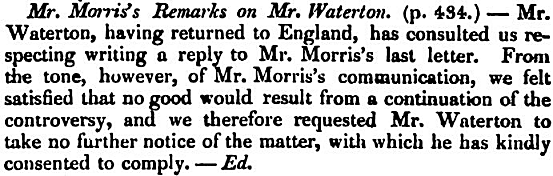
One particular spat became rather unpleasant and protracted. It involved the naturalist, explorer and conservationist, Charles Waterton, and was played out in the 1835 and 1836 editions of the Magazine of Natural History, otherwise known as Loudon's, after the founder. "Squire" Waterton of Walton Hall, Wakefield, was a well known and controversial figure having been described as "an eccentric self-indulgent Catholic aristocrat and a liar". Bizarrely, the basis of the argument with Morris was the function of a bird's oil gland! Waterton, of the Rev F O Morris, ended up by saying: "His reverence could no more see the gland of a duck through his down, than I could see his own heart through the folds of his cassock". Morris responded: "Let me only add that, while you were wandering in South America, I was acquiring an experimental knowledge in England on its native birds which you will never possess". Morris was, in fact, correct. Birds transfer oil to their bills and rub it into the feathers to protect against water-logging - preening. Waterton thought that preening was the process of removing insects and parasites from the skin. I am fortunate to have in my collection two original letters from Morris dated January 1864 to an unnamed third party, who I believe to be the amateur naturalist, Alfred Ellis (1821-1879) of Belgrave, Leicestershire, the son of John Ellis, Chairman of the Midland Railway. Having seen an article by Ellis in The Times, Morris implores him to contact Waterton seeking his knowledge on the interaction of game birds with other wildlife, "not mentioning my name", and alluding to his previous history of acrimonious exchanges. Waterton died on 27th May 1865. He was a devout catholic with links to the Vatican and a documented ancestry dating back over a thousand years including kings, queens and several saints! The family preserved their catholic faith during and after the Reformation and the purges of Henry VIII when the majority of their estates were confiscated. Charles Darwin visited Waterton in 1845. In a letter to his teacher, friend and mentor, John Stevens Henslow, Darwin said "I then visited Mr Waterton at Walton Hall, and was exceedingly amused with my visit, and with the man; he is the strangest mixture of extreme kindness, harshness and bigotry, that ever I saw."
Referring to the Magazine of Natural History mentioned earlier, several correspondents complained about the amount of space that was used up in the sarcastic exchanges between Morris and Waterton and that were more about outdoing each other than any scientific advancement. The Editor, siding with Waterton, finally called it a day. It was not the first time an editor lost their patience with the Reverend Francis Orpen Morris!
He was forthright in his opposition to and condemnation of Darwinism and the theory of evolution. Morris sent many of his sermons to the newspapers to be published in full and also took out advertisements to publicise his views. He tried to publish a book of sermons with Blackwoods who replied that they could "hardly see how any large sale can be depended upon, so as to repay the expense of printing, advertising etc."
William Poole did publish Morris's Letters to The Times on Birds etc. in 1880. A lengthy tome of nearly 300 pages. Some snippets from a rather scathing review in the Pall Mall Gazette of 5th April 1880... "Mr Morris has, we fear, made a mistake in his mode of publishing this volume." It is "rather wearisome" with a mix of "irrelevant matter." "Confusion prevails throughout the volume, to the frequent perplexity and confusion of the reader."
Please bear with me, Rev F O Morris reappears at the end of the next paragraph!
Charles Darwin wasn't the first or only person to propose a theory of evolution. It had already been widely discussed but not generally accepted by the scientific community. On 18th June 1858 Darwin received a letter from Alfred Russell Wallace describing 'natural selection'. Wallace was one of the leading evolutionary thinkers of the period and had travelled extensively in the Amazon River Basin and the Malay Archipelago. Darwin was only part way through his seminal work On the origin of Species when he received Wallace's letter. There are some suggestions that Darwin stole Wallace's glory but they were friends and collaborators rather than rivals. Darwin had a much higher profile within the scientific community and it appeared that Wallace was happy to let him take the limelight. Also, Wallace was in financial difficulties, he didn't have a wealthy family to fall back on and he could not obtain a salaried position, and, unlike most of his contemporaries, Wallace didn't have any letters after his name. Darwin was very supportive of Wallace and, along with Charles Lyell, gave him paid employment editing their books. During the summer of 1858 there was a crisis in Darwin's home village with children dying of scarlet fever so he sent Wallace's notes along with his own to Charles Lyell and Joseph Hooker, the leading geologist and biologist of the day respectively. Lyell tried to persuade Darwin to publish his Theory to pre-empt anything Wallace might publish. Darwin refused and Lyell and Hooker presented the notes and essays jointly to the Linnean Society of London on 1st July 1858. This was the first time the theory of evolution went public and was a watershed moment in the history of science. Darwin was extremely grateful to Lyell and Hooker and insisted that Wallace took equal credit. It was a difficult time for Darwin, his baby son had died three days earlier and he felt unable to attend this momentous event. Wallace was absent too, he was in the Malay Archipelago. Darwin's On the Origin of Species by Means of Natural Selection, or the Preservation of Favoured Races in the Struggle for Life was eventually published on 12th November 1859. There is a school of thought that suggests Darwin panicked when he received Wallace's papers and misinterpreted his theory as being virtually the same as his own. Accordingly, they suggest that Wallace was not, in fact, a co-discoverer of the theory of evolution by natural selection (Walter J. Bock, Proceedings of the Zoological Society, June 2009). Nearly ten years later, in 1868, Wallace sat in on a lecture at the annual meeting of the British Association for the Advancement of Science. The lecture was entitled "On the Difficulties of Darwinism" and was given by the Reverend Francis Orpen Morris. In the discussion that followed the lecture Wallace is quoted as saying that Darwin's theories could not explain moral and intellectual development in human evolution, The Athenæum 19th September 1868. It was the first public indication of a rift between the two great evolutionaries. Wallace's studies in the Malay Archipelago identified a line which separated the islands with an Asian fauna from those with an Australian fauna. The line followed a path of intense currents created by the flow of water between the Pacific and Indian Oceans which made the accidental movement of species virtually impossible. The line is still known as the Wallace Line and was the basis for the development of his theory of evolution in a similar way as the separation of the Galapagos Islands was for Darwin.
In a letter to Darwin of 28th September 1869, the great educator and biologist Thomas Henry Huxley describes another meeting of the British Association for the Advancement of Science - "Three parsons set upon you and if you were the most malicious of men you could not have wished them to have made greater fools of themselves than they did. They got considerably chaffed and that was all they were worth." The three parsons who presented papers at the meeting were Philip Freeman, Francis Orpen Morris, and James McCann. Huxley was a champion of Darwin's theory of evolution and is often described as "Darwin's Bulldog".
The Reverend Francis Orpen Morris was a complicated character. Through all the decades he worked with Fawcett they never appeared to be 'friends' and had some acrimonious exchanges. He was an opinionated, self-righteous 'do-gooder' who didn't suffer fools gladly, and probably considered anyone who disagreed with him to be a fool. "Mr. Morris has evidently no mean endowment of the organ of self-esteem; he is fully convinced that all the goodness and all the wisdom of the world centres in himself" (Sheffield Iris 26 September 1837). He was obsessively opposed to Darwinism despite his obvious deep interest in natural history. His writing style was somewhat unorthodox and not to everyone's liking. His rather unscientific approach alienated him from the academic community but made his works more accessible to the general population. Despite all this, and more, he was a significant part of the Benjamin Fawcett story, a renowned Victorian 'Parson Naturalist' and a defender of defenceless.
Fawcett/Morris collaborative bibliography:
1850. Bible Natural History. Groombridge.
1851. A History of British Birds. Groombridge.
1852. Book of Natural History. Groombridge.
1853. A History of British Butterflies. Groombridge.
1853. A Natural History of the Nests and Eggs of British Birds. George Bell.
1858. Scripture Quadrupeds. Groombridge.
1858. Scripture Birds. Groombridge.
(1861. A Natural History of British Moths. Groombridge.)
1868-85. County Seats, etc. Longmans, Green. Bell & Daldy. D. Banks. A. Clarke. Mackenzie.


