A Natural History of British Moths was an obvious successor to the hugely popular Butterflies with its exquisite illustrations by Benjamin Fawcett. (Some editions drop the adjective "Natural".)
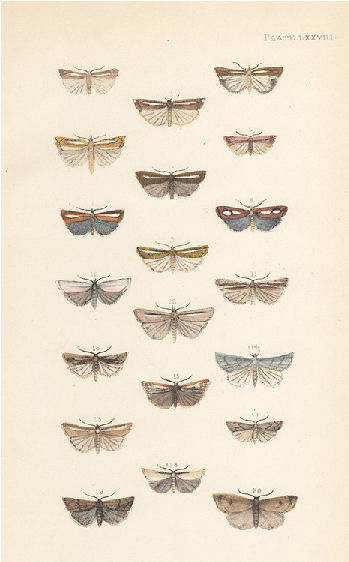
It was, however, fraught with problems. Butterflies contained illustrations and descriptions of 71 species in a single volume. It was Morris' favourite work and the text very much reflected his love of the natural world and entomology in particular. Moths was a different kettle of fish. It covered nearly 2000 species in four volumes. There were 132 pages of illustrations with up to 20 moths in each illustration. Some species were so rare that it proved very difficult, if not impossible, to obtain specimens. The text of Moths does not show the same lyrical style as Butterflies.
Fawcett refused to participate in the Moths project so Morris sought and employed his own illustrators, engravers, colourists and printers. Initially attempting Fawcett's methods of engraving on wood, they failed to produce acceptable results so resorted to a lithographic process using stone or zinc. There were arguments between the various craftsmen, some were unable to satisfactorily complete their tasks and illness caused some to withdraw. Moths was commenced in August 1859 and not completed until 11 November 1870. It was printed by Coultas of York.
Morris was frustrated by the whole project and in April 1871 he sold the copyright to Fawcett along with all the printing plates and plant. Fawcett printed most of the later editions at Driffield. It was the only work by Fawcett of any significance that didn't involve engraving on wood. "B. FAWCETT, ENGRAVER AND PRINTER, DRIFFIELD." was inserted into the back page in an untypical compressed sans serif font. Some later editions were printed by Ballantyne, Hanson and Co. after the closure of the Fawcett printing works in Driffield in 1895 and on into the early 20th century.
 |
 |


