| Poems and Novels |
|
An unusual, eclectic collection from the East Lodge presses, and Middle Street.
I thought this section would be nothing much more than a list but it continues to reveal some of the most interesting and previously unknown items in the Fawcett catalogue. Updates have been coming thick and fast and it continues to be a work in progress.
Title & Date, Author, Publisher.
●The Corsair Undated pre-1848, Lord Byron, Web Millington.
●Lara 1848?, Lord Byron, Web Millington.
●The Sacred Harp 1848?, Web Millington.
Gems from the Poets 1860, compiled by Fawcett and Lydon, Groombridge.
Robinson Crusoe 1862, Daniel Defoe, Groombridge.
Fairy Mary's Dream 1870, A F Lydon, Groombridge.
Pilgrims Progress 1871, John Bunyan, Groombridge.
The Vicar of Wakefield 1872, Oliver Goldsmith, Groombridge.
●Wood-Notes and Church-Bells 1873, Rev Richard Wilton, Bell and Daldy.
●Birkheda Vicarage 1874, Christina Johanna Augusta von Hofsten, Partridge.
●The Stark Family 1874, Christina Johanna Augusta von Hofsten, Partridge.
The Last of the Mohicans 1875, James Fenimore Cooper, Groombridge.
Mansfield Park 1875, Jane Austen, Groombridge.
Swiss Family Robinson 1878, Johann David Wyss, Groombridge.
●Lyrics: Sylvan and Sacred 1878, Rev Richard Wilton, George Bell.
●The Monk: A Romance in Two Volumes Undated 1893?, Matthew Gregory Lewis, Privately printed.
●Undocumented by McLean.
Gems from the Poets (1860)
Another classic Fawcett Lydon collaboration. Although McLean suggests that this work was probably instigated by Fawcett it's quite possible that the 23 year old Lydon was in no small part involved in its creation and execution with his love of poetry and the opportunity to give free rein to his developing artistic skills.
Fairy Mary's Dream (1870)
This was without doubt a vehicle for Lydon's talents as a poet and illustrator. Having said that, it may have been his only published poem. The illustrations are exquisite, especially the peacock feathered frontispiece.
Mansfield Park (1875)
Fawcett and Lydon were responsible for the first ever fully illustrated edition of a Jane Austen novel with the publication of Mansfield Park by Groombridge in October 1875. There are a few early nineteenth century editions of works by Jane Austen translated into French with engravings on the frontispiece but they don't qualify as illustrated editions. Fawcett's Mansfield Park contains seven full-page engravings with Fawcett and Lydon yet again showing their ability to enhance the classic works of renowned authors. Of all the books printed by Fawcett this is probably one of the least known but most desirable, particularly to collectors of works by Jane Austin. Chris Browne and Devoney Looser wax lyrical about Fawcett's illustrated edition at Book Collecting Heaven and in The Making of Jane Austin starting at page 38.
Previous editions of Mansfield Park:
1814 Three volumes, T Egerton.
1816 Three volumes, John Murray.
1833 Single volume, Richard Bentley, engraved frontispiece and vignette on the title page.
Several editions 1846-1867, no illustations or frontispiece.
1875 Single volume, Groombridge, printed by Fawcett, engraved frontispiece and six full page engravings.
The Monk: A Romance in two volumes. Privately printed by Fawcett, undated, probably 1893.
The Monk by Matthew Gregory Lewis (1775 to 1818) has been described as "one of the finest Gothic horror novels ever written." This "shocking, erotic and violent" work was written when Lewis was still a teenager and was published, anonymously (with initials only), as he turned 20 in 1795. It was an instant best seller but, unsurprisingly, it split the critics. Success meant that a second edition followed a year later in 1796 when Lewis was actually a Member of Parliament. The author is now credited as "M. J. Lewis Esq., M.P." Lewis' father was a prominent civil servant at the War Office and his son's Seat in Parliament had cost him £2,600, £325,000 in today's money (don't you just love democracy!) His parliamentary career was "brief and inglorious" and he never once attempted to address the House. Lewis was, apparently, "disliked by all man and womankind" though his close circle included Mary and Percy Bysshe Shelley, Walter Scott, Lord Byron (who thought Lewis was a good man but a damned bore) and Johann Wolfgang von Goethe. Samuel Taylor Coleridge described The Monk as blasphemous and obscene, a review that Lewis never fully recovered from. The subject matter and graphic nature of The Monk caused a rift between Lewis and his family. He subsequently wrote to his father stating that he had "expunged every syllable on which could be grounded the slightest construction of immorality" which resulted in a fourth edition in 1798. The Monk has been re-published, re-worked and appropriated dozens if not hundreds of times over the years and is probably the origin of the "Mad Monk" in many a tale. In recent years it has also been adapted for stage, screen and television. The 2002 edition of Oxford World's Classics has an introduction by Stephen King who said it had "changed the genre - and the novel itself - forever." In this edition, privately printed by Fawcett, the "publisher" is at pains to point out that this is "an unabridged reprint of the exceedingly rare first edition" in the hope that it meets "with responsive approval from literati and collectors; for whom it has chiefly been designed." Preface
Lewis had inherited some large estates in Jamaica from his father. Returning from his second voyage to the West Indies on board the Sir Godfrey Webster, he died at sea of yellow fever on 14 May 1818 aged 42. How Benjamin Fawcett came to produce this "privately printed" edition of The Monk is unknown, as is the date (see update below). Goodness knows what the Reverend Francis Orpen Morris would've thought about this book rattling off the same presses as his esteemed works! It was intended to be a limited edition of 300 though the number of copies actually printed was probably significantly less. There is a known copy which states copy number 32 of 60 where 300 has been crossed out. As far as I can ascertain, this book is not mentioned in any of the biographies or bibliographies attributing work to Benjamin Fawcett.
Update. I'm very grateful to Linda McGregor, Research Librarian at the Alexander Turnbull Library in New Zealand, for sending me some images of their rare copy. The credit at the end of both volumes is "B, Fawcett and Co., Driffield." It is in what Ruari McLean describes, possibly mistakenly, as the Stephenson Blake typeface Ancient which is frequently used by Fawcett and is an aid to attribution. Driffield is on a separate line and there are decorative lines above and below. I've trawled a number of Fawcett's works and it's exactly the same credit as in Poetical Sketches of Scarborough which was produced in 1893 by Frank Fawcett following his father's death. Although evidence is hard to come by, I think "and Co." is indicative of the limited number of works produced at East Lodge by Frank after Benjamin's death in January 1893 and before the business was declared bankrupt in June 1894. More research required!
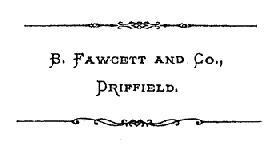 I am extremely grateful to Dr Sallie Morris, Volunteer Curator at the Type Archive, for going to considerable lengths to try and track down the "Ancient" typeface described by McLean. Sallie went into the vaults at the Type Archive in Stockwell and searched the matrices to try and confirm McLean's description. It looks like he may have been mistaken in his identification of the typeface. The typeface is more likely Two Lines Latin. Again, more research required!
I am pleased to say that I have recently managed to acquire a good copy of this very rare, two volume edition "privately printed" by Fawcett.
The Stark Family; A Sketch from Real Life and Birkheda Vicarage; the Story of a Woman's Influence (1874)
The original Swedish book, Familjen Stark: en skildring ur lifvet was written by Christina Johanna Augusta von Hofsten in 1869. An English translation was published by S W Partridge & Co. 9 Paternoster Row in 1874 - The Stark Family; A Sketch of Real Life. The credits on the title page state "From the Swedish of J.C., Author of Birkheda Vicarage." along with "Illustrated by A. F. Lydon." No translator is credited. Again, this book is not mentioned in any of the biographies or bibliographies attributing work to Benjamin Fawcett or A F Lydon. The only downloadable version I can find is an American edition, published in 1876 and with no connection to Fawcett or Lydon. The American version, published by Hitchcock and Walden of Cincinnati in 1876, is entitled Lena: or, the Stark Family. A Sketch of Real Life and credited "From the Swedish of H Hofsten by Carl Larsen." I have managed, by chance, to acquire a reprint of the 1874 Fawcett edition, more by luck than good judgement! It uses the "Ancient" typeface again. The black and white illustrations are signed by A F Lydon and the last page contains the familiar credit - "B. Fawcett, Engraver and Printer, Driffield." Reprints of the American version appear to have been available for over ten years. I haven't seen any original versions offered for sale - Swedish, British or American - though there are numerous copies listed in library catalogues.
I must admit, I didn't pay much attention to the credit "Author of Birkheda Vicarage", until recently. By chance, I came across a reference to Birkheda Vicarage in the British Library. The title page is identical to The Stark Family but with the two titles interchanged. The original Swedish version, Ett besök i Björkheda prestgård, was also written in 1869. According to the Swedish Literature Bank, Birkheda came first. The two Swedish originals contain no illustrations other than a vignette on the title page. The two 1874 versions were both published by Partridge and contain illustrations by Lydon. They were both printed by Fawcett but I can find no references in any of his bibliographies. This time I have actually managed to find a copy of the original Fawcett edition of Birkheda Vicarage.
Stark, Swedish original, 1869.
Stark, English, Fawcett, 1874.
Last page.
Birkheda, Swedish original, 1869.
Birkheda, English, Fawcett, 1874.
A mystery solved!
McLean, in his definitive list of all known books and illustrations by Fawcett, mentions seven plates in the M C F Morris papers in the Brynmor Jones Library, Hull University (now at the Hull History Centre). McLean concluded that these were for an unidentified novel that was never published, item number 100B for the year 1875, the only such entry in his catalogue of 130 items. I can reveal that the plates were, in fact, for Birkheda Village and The Stark Family. "A white cross; by this he stopped", signed A F Lydon Del, is the frontispiece and only illustration in Birkheda Village. Three of the remaining six plates, plus two not in McLean's list, are in The Stark Family. That means three of the plates on the list may have been destined for Birkheda but never actually included. Still intriguing, research continuing!
The poems of Richard Wilton: Wood-Notes and Church-Bells (1873) and Lyrics: Sylvan and Sacred (1878)
The Reverend Richard Wilton (1827-1903) was born in Doncaster, Yorkshire and educated at St. Catherine's College, Cambridge. He was ordained in 1852 eventually becoming Rector of Londesborough, about two miles from Nunburnholme where Rev F O Morris was Rector. He was the author of numerous books of poetry including the two mentioned which can definitely be attributed to Fawcett.
The following review of Wood-Notes and Church-Bells appeared in London Society, "We have in our hands, one of the sweetest books of verse, to which we have ever given a repeated and delighted perusal." A review of Poets and Poetry of the Century in The Times of 10th June 1897 has a different opinion! "The volume would be thinner and better if writers like... Rev. Richard Wilton... had been quoted more sparingly or not at all." I think The Times is probably nearer the mark!
The Corsair (Undated pre-1848), Lord Byron, Web Millington.
My recent focus on the search for early and/or undocumented works printed by Fawcett has revealed a number of intriguing items. One in particular has proved particularly interesting - The Corsair by Lord Byron. The life of Lord Byron is quite a saga and well worth investigating. George Gordon Byron was born on 22nd January 1788 into a highly dysfunctional family. At the age of ten he became the sixth Baron Byron of Rochdale on the death of his great-uncle, the "Wicked Lord Byron".
Following the success of Childe Harold's Pilgrimage in 1812, after which Byron said "I awoke one morning and found myself famous", Byron penned four "Oriental Tales" - The Giaour, The Bride of Abydos, The Corsair, and Lara. The Corsair was first published in 1814 by John Murray.
The edition printed by Fawcett, a miniature book, is very rare. There is a copy in the McGehee Miniature Book Collection, part of the Albert and Shirley Small Special Collections Library at the University of Virginia. It is the only known copy in any public collection, library or museum anywhere in the world. I'm very grateful to Grace Hale, Special Collections Librarian at the University, who kindly sent me some images of their copy. Doris Welsh, author of The History of Miniature Books and A Bibliography of Miniature Books, has suggested that there are only two known copies. There is no indication as to the whereabouts of the second copy. With that in mind, I am extremely pleased to say that I have recently managed to acquire a copy of this very rare book. Grateful thanks to Jason Burley of Camden Lock Books, specialist in miniature books.
Thanks also to Wallace Kwong and the curator of Rare Books and Music at the British Library. During a period of major technology outage, Wallace and the curator took the time to research and respond to my query about The Corsair and provided some very useful information and links for further research. It seems that The Corsair is indeed a rare item and the 1848 inscription in the copy at the University of Virginia is the only clue to the date it was published. I'm flattered and delighted that this website may be of benefit to the British Library for any future enquiries about Benjamin Fawcett. Many thanks Wallace.


Lara, Lord Byron, Web Millington.
Update December 2024. I recently came across a book written by Eneas Mackenzie and published by Webb Millington - Memoirs of Mrs. Caroline Chisholm 1852. It's a third edition, the Emigrants and Railway Edition, specifically published to appeal to those seeking a new life in Australia and also for travellers on the new form of transport - the railway. The printer is not identified. The second edition states printed by Webb Millington. I mention this third edition not because it may have been printed by Fawcett but because it has some interesting advertisements on the reverse of the last page and on the back cover. Both include the familiar first Fawcett/Morris collaboration - Bible Natural History. The back page includes "A Series of Elegant Miniature Books. 64mo. Cloth, Gilt Edges. Price 6d each." There are four miniature books listed, Byron's Corsair and Lara plus Precepts and Maxims and The Sacred Harp. I can find no records of or references to the latter two, not even in Welsh's History or Bibliography of miniature books. I can find no record of this edition of Lara on WorldCat, Library Hub Discover or any other catalogue that I've searched. Welsh does mention two known copies and I found a single reference online in an old bookseller's catalogue describing it as "sold", unknown date. It must overtake Corsair as a candidate for the most rare of all the known books in the Benjamin Fawcett portfolio. I was very surprised and quite overwhelmed when, shortly after this discovery, I actually managed to find a copy for sale online. It arrived today. I think this is a classic illustration of the sometimes obscure routes and lucky breaks that can lead to the discovery and acquisition of the previously unknown and rarest of books. I do not take my good fortune for granted.Update May/June 2025. I've been looking again at the four miniature books described above. I didn't realise that WorldCat had recently been redesigned. It's taking a bit of getting used to and has been giving me incorrect or inconsistent results plus an occasional "Unable to get libraries with this item at the moment. Try again later!" My new search found one copy of Corsair, at Harvard University, no mention of the copy at the University of Virginia. Then I got 2 copies, the Harvard one plus a copy at the Victoria State Library, Australia - "2 miniature books by Lord Byron, namely Lara: a tale and The Corsair: a tale. Leeds: Webb, Millington and Co." Lara and Corsair, together! Amazing! More details to come.
A search for The Sacred Harp published by Webb, Millington on Worldcat does bring up a result, OCLC Number: 50337538. It then it goes on to say "Unable to find libraries on WorldCat with this item." I had an extensive exchange with Tom Petticrew of the OCLC help service (Online Computer Library Center, the providers of WorldCat). There's nothing they can do when a library gives WorldCat access to their catalogues but chooses to remain anonymous! There are many versions of The Sacred Harp out there but only one published by Webb Millington as far as I know. After many hours of searching online I found a single copy. It may or may not be the copy on Worldcat. Again, more details to come.
Update, September 2025. The copy of The Sacred Harp is in the library of the Western Reserve Historical Society (WRHS), Cleveland, Ohio. I'm extremely grateful to Eric Rivet, chief curator at the WRHS, who confirmed their copy and kindly sent some images. Currently, it is most definitely the rarest book in the Benjamin Fawcett portfolio.Front Cover Title Page First Page


Again, grateful thanks to Eric Rivet and the WRHS, well worth a visit.
Still no sign of Precepts and Maxims.


