| A History of British Birds |
|
Work in progress...
While I'm waiting to add more content to this page, here's some information on the history of Birds and version identification from prints, as I understand it. Comments/corrections welcome.
A History of British Birds is Fawcett's most well known work. It was revolutionary, bringing coloured illustrations of birds in their environment to a wide audience. Morris' aim was "to simplify former descriptions, to adapt them to popular wants and wishes." However, it did not gain universal approval. It was written "in a popular style" which was not to everyone's liking and the scientific establishment was not impressed. In a review of McLean's book on Fawcett, William Noblett said of Birds that "it is a work of extraordinary banality and inaccuracy". It was the quality of Fawcett's illustrations that propelled it into a position of wide acclaim.
Following their collaboration on Bible Natural History, Fawcett invited Morris to write the text for A History of British Birds, a work that he had been planning for some time. Collaboration on Birds was well under way when "Bible" was published in 1850. Birds was initially published in
monthly parts in a green paper cover at a cost of one shilling. The first part was published on 1st June 1850. Each part consisted of 24 pages of letterpress and four hand-coloured illustrations. Queen Victoria and Prince Albert were very impressed with Birds. Part 32 (January 1853) and all subsequent parts and re-issues were adorned on the front cover with a dedication to the Queen, with her permission.
The publisher, Groombridge, suggested a run of 1000 for the first part, a massive underestimate of the demand. It was the success of Birds that forced Fawcett to move to larger premises at East Lodge in October 1850 after just five of the monthly issues. Due to that unprecedented demand, and well before publication of all the 90 monthly parts, the series was re-issued. This became complicated and it is likely that several re-issues took place, initially to meet the shortfall in numbers of the early parts and then to meet the increased demand as the popularity of Birds took off. All re-issues from 1853 onwards display the Queen's dedication. A later re-issue in a mauve cover with each part containing two of the original parts was available at a cost two shillings. This re-issue actually had "RE-ISSUE" printed on the front cover along with the two original part numbers.
I am fortunate to have two bound volumes of the monthly parts, all post dedication I think, including some of the later two-part re-issues. Some covers are included but not all. I am also extremely fortunate to have recently managed to acquire parts 1 and 2 of the monthly issue. Interestingly, part 1 has the dedication to the Queen, part 2 does not. That must mean that this part 1, in the original four bird format, must have been part of a re-issue of the original on or after 1st January 1853. Part 2 must be an original issue from February 1850. Also, the back cover of the original issue part 2 is blank, the back cover of the re-issued part 1 is covered with advertisements for Groombridge's School Books and Maps, another useful indicator.
Fawcett himself engraved all the blocks for Birds. There were usually two blocks per bird, one printed in black and one in grey. The prints were then hand coloured. It is often stated that A F Lydon was the artist and engraver for Birds. This is obviously not the case. Lydon was born in 1836 and joined Fawcett as an apprentice aged 14 in about 1850. The first monthly parts were already off the presses and Lydon was only just starting to learn his trade. It is possible that Lydon produced illustrations for the extended later editions. There are two known Birds illustrations signed by Lydon. The Desert Wheatear, signed AFL, appeared for the first time in volume 3 of the 1891 third edition, eight years after Lydon had left Fawcett's Driffield printing works and moved to London. The Green-winged Teal appeared in volume 5 of later editions and is also signed AFL. It is possible, even likely, that other unsigned illustrations in the later editions were by Lydon but such an attribution would be somewhat speculative.
Fawcett and Morris were well aware of the ornithological illustrations of Bewick, Yarrell and Macgillivray, and they would have been influenced by them. Fawcett and Morris were keen to show birds in their natural state and habitat rather than the inanimate more academic illustrations taken from dead specimens. Morris' close friend, Rev Richard Alington, was probably the most influential advisor on bird illustration, including the controversial hovering pose of the kestrel or windhover. Fawcett himself was a keen ornithologist and his expertise would also have played a part. There are pages and pages of criticisms and corrections in the archives that Morris sent to Fawcett concerning the illustrations for Birds, an example of their perhaps less than harmonious relationship. Undocumented by M C F Morris or McLean, F O Morris also consulted other well known naturalists. I have an 1851 letter from Thomas Edward to Morris at his Nafferton address, a
rather terse reply
correcting Morris' identification of a lark. Edward was a penniless shoemaker but also a renowned Scottish naturalist who had unsuccessfully tried to make a living as a taxidermist. A biography by Samuel Smiles, Life of a Scottish Naturalist, brought Edward wide acclaim. In 1877 he was awarded a £50 a year pension by Queen Victoria and 333 gold sovereigns by the great and good.
I must thank David Godden for a most interesting exchange of information recently. In particular, David pointed out the very close resemblance of some illustrations in Birds to those in William Lewin's Birds of Great Britain 1795. Also, the Egyptian Vulture in the 1903 fifth edition of Birds is very much a mirror image of the one in John Gould's Birds of Europe 1832-37. I've just scanned McLean's book and M C F Morris' memoirs of his father F O Morris and of Fawcett. I can't find any mention of Lewin or Gould, I can't recall coming across either of them in the archives either. Further research urgently required!
The first and subsequent fully bound editions of Birds consisted of six volumes, apart from the one-off Cabinet Edition of eight volumes. The latter had a smaller page size but the same size and quality of illustration. It was produced more cheaply and aimed at a wider audience.
Context in 1850
Average earnings were about 15s a week (75p).
Farm labourers earned about half that, 7s 6d a week (37.5p).
A loaf of bread cost about 6d (2.5p).
A monthly part of Birds cost 1s, re-issue 2s.
A six volume set of Birds cost £5. That's over three months' wages for a farm labourer!
A single volume of the Cabinet Edition cost 7s 6p, that's £3 for the full eight volume set.
1s in 1850 would equate to about £6.80 in 2020, £5 would be about £680, 7s 6p would be nearly £50!
Note
1. Fonts: a serif is a little tapering line on the end of a stroke.
This is SERIF
This is SANS SERIF
(Sans comes from the French for 'without' and originates from the latin 'sine'.)
2. When buying prints, beware of pages from the Peerage edition 1980-84. The font is a modern serif in italics. There may be two birds per page offset and text on the reverse. It's a great book by the way, the prints are excellent reproductions of the originals. The book is currently less than £2.50 on eBay including postage!
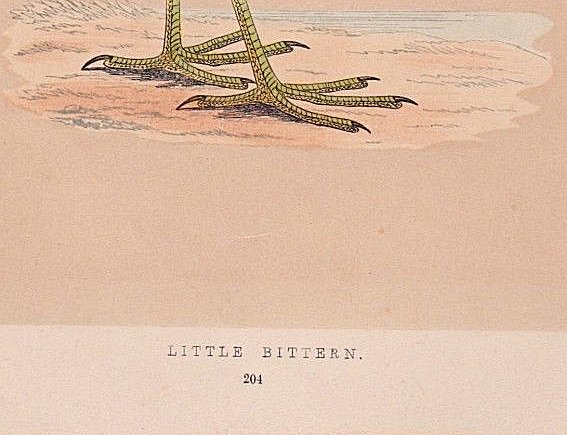
First Edition, first impression.
Published by Groombridge, 358 illustrations, six volumes.
Volume 1 1851
Volume 2 1852
Volume 3 1853
Volume 4 1855
Volume 5 1856
Volume 6 1857
Serif font, illustration number below bird's name unique to first/first, biscuit coloured background.
Also as in the green covered first issue of monthly parts.
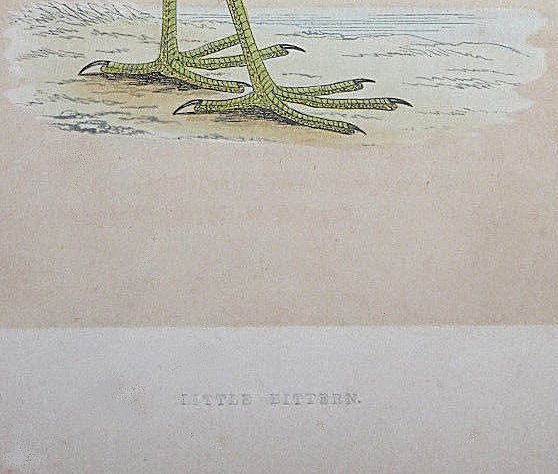
First Edition, second and third impressions.
Serif font, NO illustration number, biscuit coloured background.
There is evidence to suggest that some second impressions contained an occasional illustration with number, probably left over from the first impression.
Also as in the mauve covered re-issue of monthly parts.
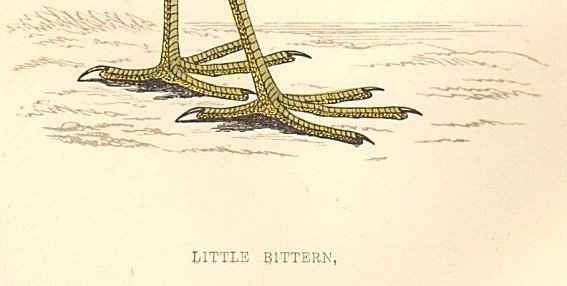
Cabinet Edition.
Eight volumes bound in red, 1863-67, published by Groombridge, 358 illustrations.
Narrow serif font, no illustration number, no background, illustration same size but narrower borders and name closer to illustration.
Most illustrations lack colouring to the habitat.
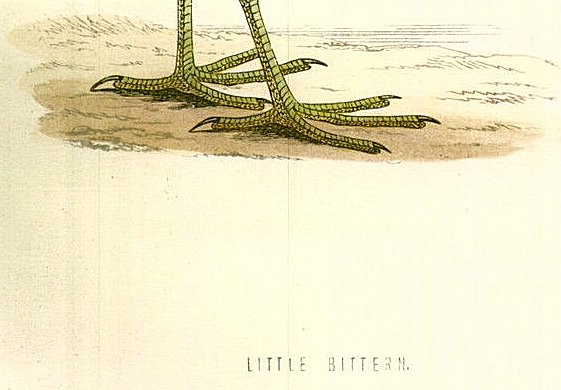
Second Edition, 1870, published by Bell and Daldy, 365 illustrations.
The supposedly "preferred" edition, though not in my opinion.
Narrow sans serif font unique to second, no illustration number, no background.
Later Editions, serif font, no illustration number, no background.
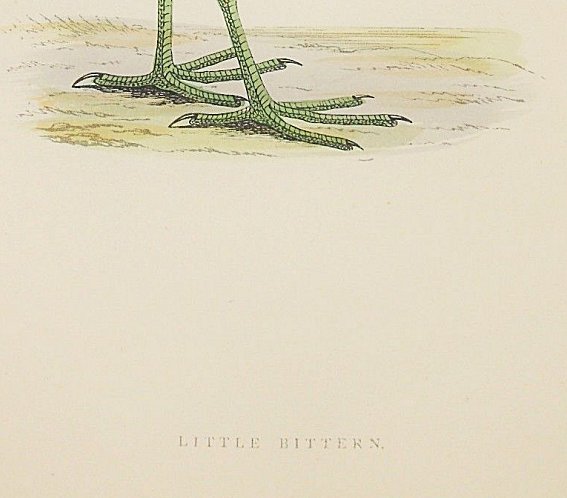
Third Edition, 1891, published by Nimmo, 394 illustrations.
Fourth`Edition, 1895/6, published by Nimmo, 394 illustrations.
Fifth Edition, 1903, published by Nimmo, distibuted by Routledge, 400 illustrations.


